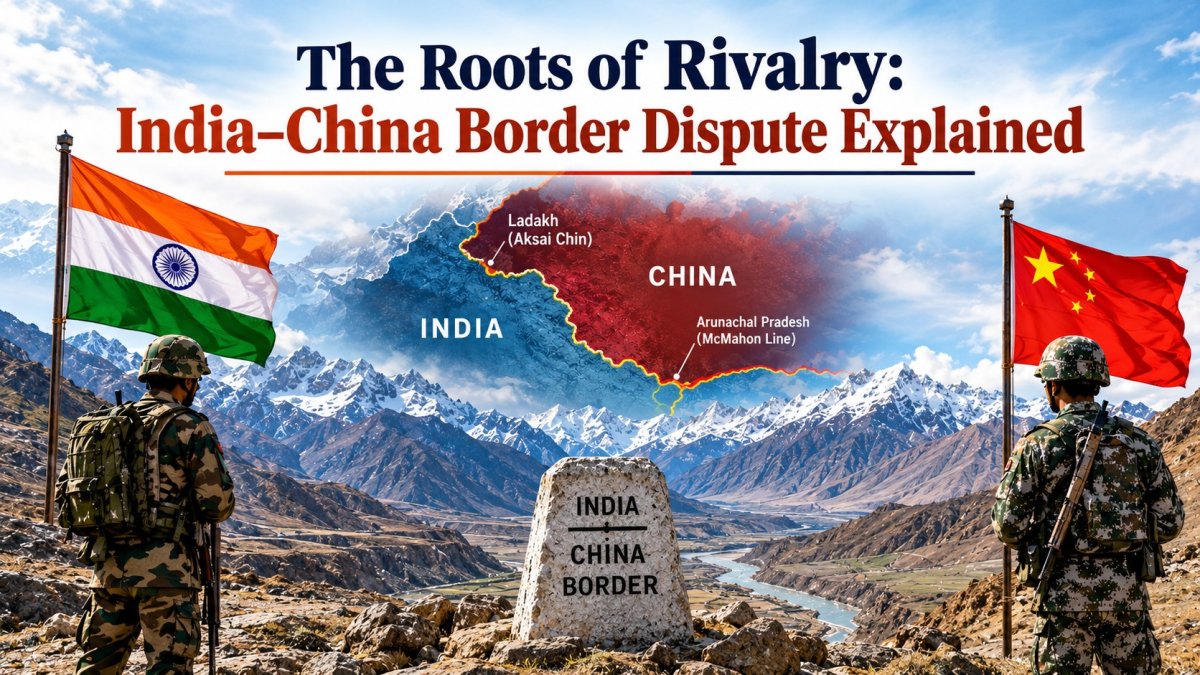
The Roots of Rivalry: India–China Border Dispute Explained
The India–China border dispute is one of Asia’s longest-running territorial conflicts. Rooted in colonial-era boundary arrangements, competing historical claims and strategic rivalry, the dispute continues to influence relations between the two Asian powers. Although both countries share a vast Himalayan frontier, they disagree over the alignment of significant sections of their boundary.
Understanding the origins of this dispute requires examining British colonial policies, the historical position of Tibet, competing claims over Aksai Chin and the McMahon Line, and the consequences of the 1962 war. These historical developments continue to shape military planning, diplomatic negotiations and regional security.
1. The Historical Background of the India–China Border
The modern India–China border was not established through a single agreement accepted by both countries. Historically, the Himalayan frontier included areas influenced by different kingdoms, regional authorities and Tibetan administrations. Difficult terrain and limited surveying made it challenging to establish a clearly defined boundary across the entire region.
Competing Historical Claims
After India gained independence in 1947, it inherited the territorial boundaries and claims of British India. The People's Republic of China, established in 1949, challenged several colonial-era boundary arrangements, arguing that some had not been validly agreed upon.
India generally maintained that historical agreements, administrative practices and established boundaries supported its territorial claims. China advanced different interpretations of the frontier's history. These competing positions created a dispute that became increasingly serious as both governments strengthened their presence in border regions.
2. British Colonial Rule and the Origins of the Dispute
British colonial policies played a significant role in shaping the modern territorial disagreement. British officials viewed the Himalayan region as strategically important for protecting northern India and managing relations with neighbouring powers. Their boundary proposals changed over time according to imperial security concerns and political developments.
The Legacy of Colonial Boundary-Making
During the nineteenth and early twentieth centuries, British authorities proposed different boundary alignments in the western and eastern Himalayan regions. Some proposals were never formally accepted by all parties, while others remained subject to disagreement.
When British rule ended in 1947, India inherited a frontier containing unresolved questions. China did not accept every boundary arrangement associated with British India, and the two countries subsequently developed conflicting territorial positions. The colonial legacy therefore became an important foundation of the modern dispute.
3. The McMahon Line and the Eastern Sector
The eastern sector of the dispute primarily concerns Arunachal Pradesh, which India administers as a state and China claims in substantial part. The disagreement centres on the McMahon Line, a boundary proposed during negotiations involving British India, Tibet and China in the early twentieth century.
The Simla Convention of 1914
The McMahon Line emerged from the Simla Convention of 1913–1914. British representative Sir Henry McMahon helped establish the proposed boundary between British India and Tibet. British Indian and Tibetan representatives accepted the arrangement, but the Chinese government did not accept the final settlement.
India recognises the McMahon Line as the basis of its eastern boundary. China rejects it and refers to Arunachal Pradesh as “South Tibet.” The two governments' conflicting interpretations have prevented a mutually accepted settlement.
The region's mountainous terrain, strategic passes and proximity to Tibet make it important for both countries. The eastern sector became a major battlefield during the 1962 war, and the dispute remains a sensitive issue in bilateral relations.
4. Aksai Chin and the Western Sector
Aksai Chin is a strategically important high-altitude region claimed by India as part of Ladakh but controlled by China. Despite its harsh climate and sparse population, the territory has considerable geographical significance because it connects China's Xinjiang and Tibet regions.
Strategic Importance of Aksai Chin
During the 1950s, China constructed a road through Aksai Chin linking Xinjiang and Tibet. India objected to the construction because it regarded the territory as Indian land. The road highlighted the fundamental disagreement between the two countries over the western boundary.
Historical proposals, including the Johnson Line and the Macartney–MacDonald Line, reflected different approaches to defining this frontier. India has generally supported a boundary alignment that places Aksai Chin within its territory, while China maintains control over the region and rejects India's claim.
The disagreement remains central to military deployments and diplomatic negotiations along the western sector of the Line of Actual Control.
5. Tibet’s Role in the Border Dispute
Tibet's political status has been an important factor in the development of the India–China border dispute. Historically, Tibet maintained changing relationships with Chinese imperial governments and neighbouring territories. Its position created complicated questions about political authority, diplomacy and the validity of boundary agreements.
Political Changes in Tibet
China established control over Tibet during the early 1950s, transforming the strategic environment along India's northern frontier. India and China initially sought friendly relations, but differences over Tibet and the border gradually weakened mutual trust.
In 1959, the Dalai Lama fled to India following unrest in Tibet, and the Indian government granted him asylum. China viewed this development with suspicion, while India presented its decision as humanitarian. The episode further strained relations at a time when territorial disagreements were already intensifying.
Tibet's importance therefore extended beyond the border itself. Its political transformation contributed to the strategic circumstances in which the India–China dispute developed.
6. The 1962 War and Its Lasting Consequences
Border tensions eventually escalated into war in October 1962. Disagreements over territorial claims, China's road through Aksai Chin, patrol encounters and competing security policies contributed to the conflict.
A Turning Point in Bilateral Relations
Chinese forces launched offensives in the eastern and western sectors on 20 October 1962. Indian forces faced significant challenges, including difficult terrain, logistical weaknesses and inadequate preparation for the scale of the fighting.
China declared a unilateral ceasefire in November and withdrew from much of the territory it had occupied in the eastern sector, while retaining control over Aksai Chin. The war ended without a comprehensive boundary settlement.
The conflict deeply affected India's security policy and increased distrust between the two countries. India strengthened its military preparedness and later expanded infrastructure along the frontier. Although diplomatic relations eventually improved, the fundamental territorial disagreement remained unresolved.
7. Why the Dispute Remains Unresolved?
The India–China border dispute persists because the two countries continue to disagree over historical agreements, territorial sovereignty and the precise alignment of their frontier. Strategic competition and domestic political considerations make compromise difficult.
The Line of Actual Control and Strategic Competition
The Line of Actual Control separates areas controlled by India and China, but its alignment is not mutually agreed upon everywhere. Differences in perception have contributed to patrol confrontations and military standoffs. The LAC is not the same as a formally agreed international boundary.
Both countries have invested in roads, bridges, military facilities and other infrastructure near the frontier. These developments improve access to remote areas but can also intensify suspicion and competition.
Diplomatic and military negotiations have helped manage tensions, but a lasting solution requires greater clarity about disputed areas and sustained political commitment. Until a mutually accepted boundary is established, communication and confidence-building measures remain essential to preventing local confrontations from escalating.
Conclusion
The roots of the India–China border dispute lie in colonial-era boundary proposals, competing historical interpretations, Tibet's political transformation and the strategic importance of territories such as Aksai Chin and Arunachal Pradesh. The 1962 war turned these disagreements into a lasting security challenge.
Although both countries have pursued negotiations and mechanisms to manage tensions, their competing territorial claims remain unresolved. Understanding the dispute's historical origins is essential to assessing its present significance. A peaceful settlement will depend on sustained diplomacy, effective crisis management and the willingness of both governments to prevent territorial disagreements from destabilising regional security.
Sources and Further Reading
1. Historical Note on the Sino-Indian Dispute over Aksai Chin
2. A Battle for “Barren Land” — China's Interests in the Sino-Indian Border Dispute
3. Report on the India–China Boundary Question (1961)
4. The Himalayan Border Dispute — Research Paper
https://www.defence.gov.au/sites/default/files/research-publication/2015/Richards_feb15.pdf
Join the Conversation