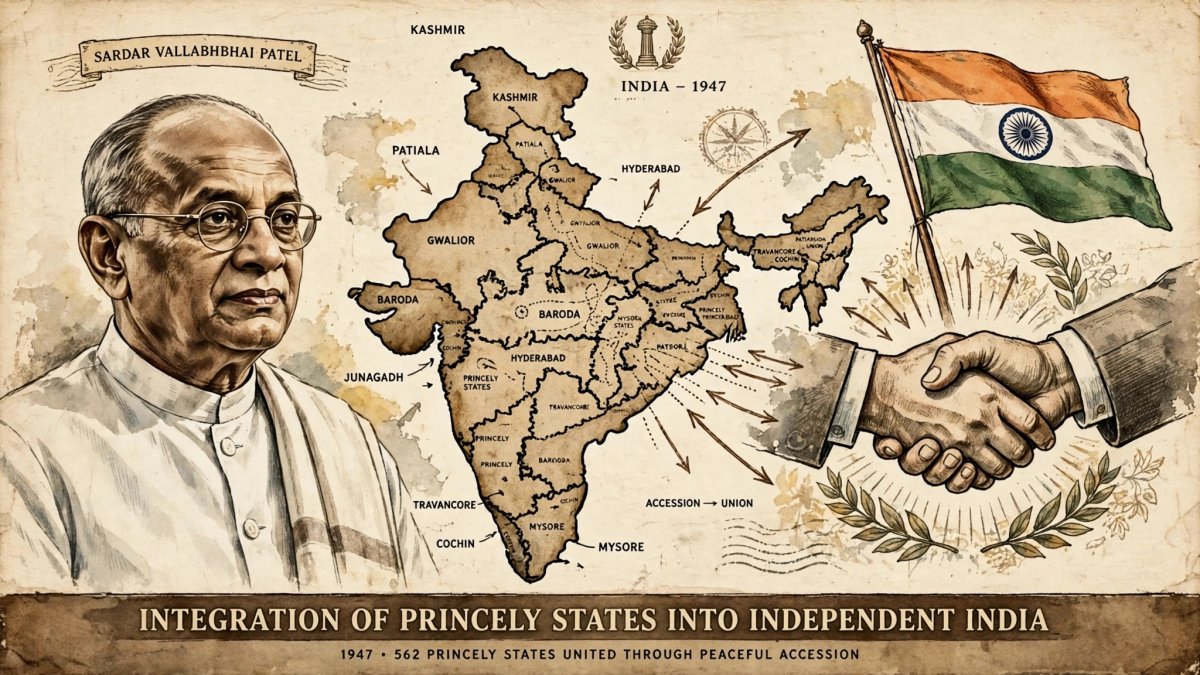
How India Integrated the Princely States After Independence: The Making of a United Nation
New Delhi, October 26, 2026
India's independence on August 15, 1947, marked the end of British colonial rule, but it also ushered in one of the most challenging periods in the country's political history. The task before the new leadership extended beyond establishing an independent government. India also had to bring hundreds of princely states into a unified political and constitutional framework while navigating competing interests, territorial disputes and questions of sovereignty.
The integration of these states became a defining chapter in the formation of modern India. It required a combination of diplomacy, legal agreements, political negotiations, administrative reforms and, in certain cases, military intervention. The process was neither uniform nor entirely peaceful, reflecting the immense complexity of transforming a diverse subcontinent into a functioning independent nation.
At the centre of this historic effort stood Sardar Vallabhbhai Patel, India's first Deputy Prime Minister and Minister of States, alongside V. P. Menon, a senior civil servant whose administrative expertise and negotiating skills played a significant role in shaping the process.
More than a simple exercise in territorial consolidation, the integration of princely states laid important foundations for India's political unity, administrative coordination and constitutional development.
1. India at Independence: A Complex Political Landscape
Before independence, the Indian subcontinent was divided into two broad categories of territory. British Indian provinces were administered directly by the colonial government, while princely states were governed by hereditary rulers who exercised varying degrees of internal authority under the British system of paramountcy.
According to the Government of India's historical account, approximately 565 princely states existed around the time of independence. They differed considerably in geographical size, population, financial resources, administrative capacity and political circumstances. Some controlled extensive territories, while others consisted of comparatively small areas.
The Indian Independence Act of 1947 brought British rule to an end and terminated British paramountcy over the princely states. Consequently, the existing political relationship between the British Crown and these rulers ceased, creating an urgent need to determine their future status.
The new dominions of India and Pakistan emerged within this changing political landscape. The question of how the princely states would relate to these dominions carried major implications for national security, trade, transport, communications and administrative continuity.
An arrangement under which numerous states remained politically separate could have created serious challenges for coordination across the subcontinent. However, persuading rulers to enter the new political framework required sensitivity to their individual circumstances and an understanding of the wider interests of the populations they governed.
The integration process therefore began against a background of uncertainty, competing ambitions and the urgent need to establish stable political institutions.
2. Sardar Vallabhbhai Patel and V. P. Menon: Leadership Behind Integration
The integration of the princely states is closely associated with Sardar Vallabhbhai Patel and V. P. Menon, two figures whose responsibilities complemented one another during this critical period.
Patel provided political leadership as India's first Deputy Prime Minister and Minister of States. He recognised that the future stability of the country depended on establishing workable relationships between the new Indian government and the princely rulers.
V. P. Menon, who served as Secretary of the States Department, played a major role in the administrative and negotiating work. Established in July 1947, the department was responsible for managing the relationship between the Indian government and the princely states.
The approach combined political persuasion, legal arrangements and practical negotiations. Rather than treating every state identically, the government worked to address the concerns of rulers while advancing the broader objective of political integration.
However, the achievement cannot be attributed to Patel and Menon alone. Prime Minister Jawaharlal Nehru, Lord Mountbatten, government officials, regional leaders and popular political movements also influenced the process. Their contributions reflected the complex interaction between national leadership, local political developments and changing public expectations.
Menon's 1955 book, The Story of the Integration of the Indian States, remains an important firsthand account of the negotiations, administrative decisions and difficulties involved in bringing the princely states into the Indian Union.
Historical source: V. P. Menon, The Story of the Integration of the Indian States
https://kprijk.org/wp-content/uploads/2024/01/V.P.Menon-Integration-of-Princely-States.pdf
3. The Instrument of Accession: Establishing a Legal Framework
One of the most significant instruments used during the integration process was the Instrument of Accession. It provided a formal mechanism through which a princely state could accede to India.
Under the initial arrangement, accession generally covered three principal areas of responsibility: defence, external affairs and communications. These were essential functions for maintaining security, conducting international relations and coordinating connections across territories.
Standstill agreements were also used to preserve existing administrative and practical arrangements while the future relationship between the states and the new dominions was being worked out.
This framework helped establish an initial relationship between the princely states and the Indian government without immediately requiring every state to adopt an identical administrative system. Further agreements and political developments subsequently enabled deeper integration.
The accession process was therefore more than a symbolic declaration. It established legal and administrative foundations for a wider transformation that would continue over the following years.
The Government of India's White Paper on Indian States, published in 1950, records the arrangements and developments associated with accession and subsequent integration.
Historical source: Government of India, White Paper on Indian States (1950)
https://en.wikisource.org/wiki/White_Paper_on_Indian_States_%281950%29
4. Junagadh: A Dispute Over Accession and Popular Will
Junagadh, located in the Kathiawar region of present-day Gujarat, became one of the earliest and most prominent challenges facing the Indian government.
In 1947, the Nawab of Junagadh announced the state's accession to Pakistan. The decision generated considerable opposition from Indian authorities and local political groups, particularly given Junagadh's geographical position within the Indian peninsula.
The dispute brought several difficult questions to the forefront. How should the future of a princely state be determined when the decision of its ruler conflicts with the preferences expressed by local political groups? What role should geographical continuity play? And how should competing claims of political authority be resolved during the transition from colonial rule?
Political instability intensified, and Indian authorities eventually assumed administration of Junagadh. A referendum was held in February 1948, with the reported result showing overwhelming support for joining India.
The episode became an important example of the competing considerations that shaped princely-state integration. It demonstrated that accession disputes could not always be resolved through legal instruments alone; political legitimacy, local opposition and strategic geography also influenced the outcome.
Junagadh's history remains relevant to understanding the difficult questions surrounding sovereignty and public participation during India's transition to independence.
5. Hyderabad: Integration Through Negotiation and Military Action
Hyderabad presented a different and more complex challenge. Ruled by the Nizam, it was one of the largest and most influential princely states, occupying an extensive area of the Deccan and surrounded by Indian territory.
The Nizam sought to preserve Hyderabad's separate status rather than immediately accede to India. Negotiations continued as political tensions increased, internal unrest grew and disagreements over the state's future became more serious.
The situation presented the Indian government with a major strategic concern. Hyderabad's geographical position, size and relationship with the surrounding Indian territories made its political status particularly significant to the stability of the newly independent country.
In September 1948, the Indian government launched a military operation known as Operation Polo. Indian forces took control of Hyderabad, and the state subsequently became part of the Indian Union.
The events surrounding Hyderabad's integration remain an important and contested subject in Indian history. They raise questions about state sovereignty, the limits of negotiation, the use of military force and the consequences of political conflict for ordinary people.
A comprehensive understanding of this episode must acknowledge the Indian government's stated strategic concerns while also examining the experiences of Hyderabad's population, the violence associated with the period and the broader humanitarian consequences.
Hyderabad illustrates that the formation of the Indian Union was not achieved through peaceful negotiation in every case. Some disputes required decisions that continue to attract historical scrutiny and debate.
6. Jammu and Kashmir: Accession Amid War and Uncertainty
Jammu and Kashmir presented circumstances different from those of most other princely states. Its ruler, Maharaja Hari Singh, initially delayed making a final decision about accession to either India or Pakistan.
The situation changed dramatically in October 1947, when armed tribal forces entered the territory from the direction of Pakistan. Facing the attack, the Maharaja sought military assistance from India and signed the Instrument of Accession to India. Indian troops were subsequently deployed.
The accession became closely connected with the first India–Pakistan war and the emergence of an enduring international dispute over Kashmir.
Unlike many other princely states, Jammu and Kashmir's political future remained contested long after the initial accession. Its subsequent history was shaped by armed conflict, constitutional developments, political disagreements and diplomatic efforts.
The case highlights the limits of treating princely-state integration as a single, uniform historical process. Although accession provided the initial legal basis for the relationship with India, the circumstances surrounding Jammu and Kashmir created a distinctive legacy that continued to influence regional politics.
Its history also demonstrates how the decisions made during the uncertain months following independence could have consequences extending far beyond the immediate transition from colonial rule.
7. The Integration of Smaller States: Building Administrative Unity
Public attention often focuses on Junagadh, Hyderabad and Jammu and Kashmir because of their political significance and the controversies surrounding their accession. However, the integration of hundreds of smaller princely states was equally important to the practical construction of the Indian Union.
Many of these states lacked the administrative structures, financial resources or territorial scale required to function effectively as independent political units within the emerging national framework.
The Indian government therefore pursued mergers, administrative reorganisations and the formation of regional unions. Several states in western India were brought together in Saurashtra, while other arrangements contributed to the political and administrative organisation of regions that included present-day Rajasthan, Madhya Pradesh and Himachal Pradesh.
These reorganisations helped establish more workable administrative units and facilitated coordination in areas such as transport, revenue collection, governance and public services.
The task extended well beyond obtaining signatures on accession documents. Authorities also had to reconcile different administrative systems, establish more coordinated institutions and determine how former princely territories would operate within a broader political structure.
For many smaller states, consolidation provided a practical route towards participation in a modern system of government. At the same time, the process required political decisions about representation, administrative authority and the future organisation of territories.
The integration of these states was therefore an essential part of the wider effort to turn the idea of a united India into an operational political reality.
8. From Political Accession to Constitutional Integration
The accession of princely states in 1947 did not immediately complete the process of national integration. It marked the beginning of a wider transformation involving the organisation of government, the distribution of political authority and the development of a common constitutional framework.
Between independence and the early 1950s, the Indian government worked to strengthen central institutions, reorganise former princely territories and establish more consistent administrative relationships between the Union and the states.
The Constitution of India came into effect on 26 January 1950, establishing the constitutional framework of the Indian republic. Its adoption marked a decisive stage in the country's transition from colonial rule to a system of democratic constitutional government.
This transformation involved more than defining India's territorial boundaries. It required decisions about legislative powers, financial arrangements, government responsibilities and the relationship between the Union and the constituent states.
The debates of the Constituent Assembly provide important evidence of the questions that lawmakers faced while shaping the new republic. Integrating territories under a common constitutional structure required careful consideration of how authority would be exercised and how government would function across a diverse country.
The emergence of the republic thus represented a major stage in the integration process. Political accession and territorial consolidation had to be followed by institutional development to create a sustainable system of national governance.
9. The Historical Significance of India's Integration
The integration of the princely states helped establish the territorial and administrative foundations of modern India. It brought regions previously governed under different arrangements into a wider political structure and strengthened the capacity for coordinated national administration.
Its significance can be understood through several interconnected developments.
First, territorial consolidation strengthened political continuity. Bringing the princely states into the Indian Union helped establish a more coherent political framework across the country at a time when independence had created uncertainty about the future of numerous territories.
Second, integration supported administrative coordination. Mergers and reorganisations made it easier to develop common institutions and coordinate responsibilities across regions that had previously operated under different systems.
Third, the process demonstrated the importance of political negotiation. The Instrument of Accession and subsequent agreements provided mechanisms through which many rulers could establish formal relationships with the new Indian government.
Fourth, the experience exposed the challenges of reconciling competing interests. The contrasting histories of Junagadh, Hyderabad and Jammu and Kashmir reveal how geography, the decisions of rulers, political movements, security concerns and the use of force shaped different outcomes.
Finally, integration helped create the conditions for the development of a common constitutional system. The establishment of the republic in 1950 provided the institutional framework within which India's political unity could be maintained and democratic government developed.
These achievements should not obscure the complexities and controversies of the period. A balanced historical account must recognise the diplomatic and administrative accomplishments while also examining the conflicts, political disagreements and human consequences associated with particular cases.
Understanding both dimensions provides a more complete explanation of how the modern Indian state emerged.
Conclusion: A Defining Chapter in the Making of Modern India
The integration of India's princely states was one of the most consequential undertakings of the early post-independence period. It transformed a complicated political landscape inherited from British rule into the foundations of a unified constitutional republic.
Sardar Vallabhbhai Patel and V. P. Menon played prominent roles in the process, supported by a wider network of political leaders, officials, negotiators and regional actors. Through diplomacy, legal agreements, political negotiations, territorial mergers and, in certain cases, military action, the Indian government worked to establish a more coherent political and administrative system.
The experiences of Junagadh, Hyderabad and Jammu and Kashmir demonstrate that this transformation followed different paths and produced different political legacies. Meanwhile, the integration and reorganisation of smaller states provided the administrative foundations necessary for effective governance across the country.
The adoption of the Constitution in 1950 marked a major milestone in this longer process, connecting territorial consolidation with the establishment of a common constitutional framework.
More than seven decades later, the integration of the princely states remains central to understanding the origins of modern India. It was a story of political vision and institutional development, but also one of difficult choices, competing claims and enduring historical debates.
Examining this period in its full complexity offers a deeper understanding of how India sought to build national unity while navigating the extraordinary challenges of independence.
Sources and Further Reading
-
Press Information Bureau, Government of India: Sardar Patel: Man Who United India
https://www.pib.gov.in/newsite/printrelease.aspx?lang=2®=3&relid=172053 -
V. P. Menon: The Story of the Integration of the Indian States
https://kprijk.org/wp-content/uploads/2024/01/V.P.Menon-Integration-of-Princely-States.pdf -
Government of India, Ministry of States: White Paper on Indian States (1950)
https://en.wikisource.org/wiki/White_Paper_on_Indian_States_%281950%29 -
The Indian Express: Remembering V. P. Menon's Role in the Accession of Jammu and Kashmir and Other States
https://indianexpress.com/article/explained/remembering-vp-menons-role-in-accession-of-jk-and-other-states-6039385/ -
Constitution of India: Constituent Assembly Debates, 12 October 1949
https://www.constitutionofindia.net/debates/12-oct-1949/
Join the Conversation