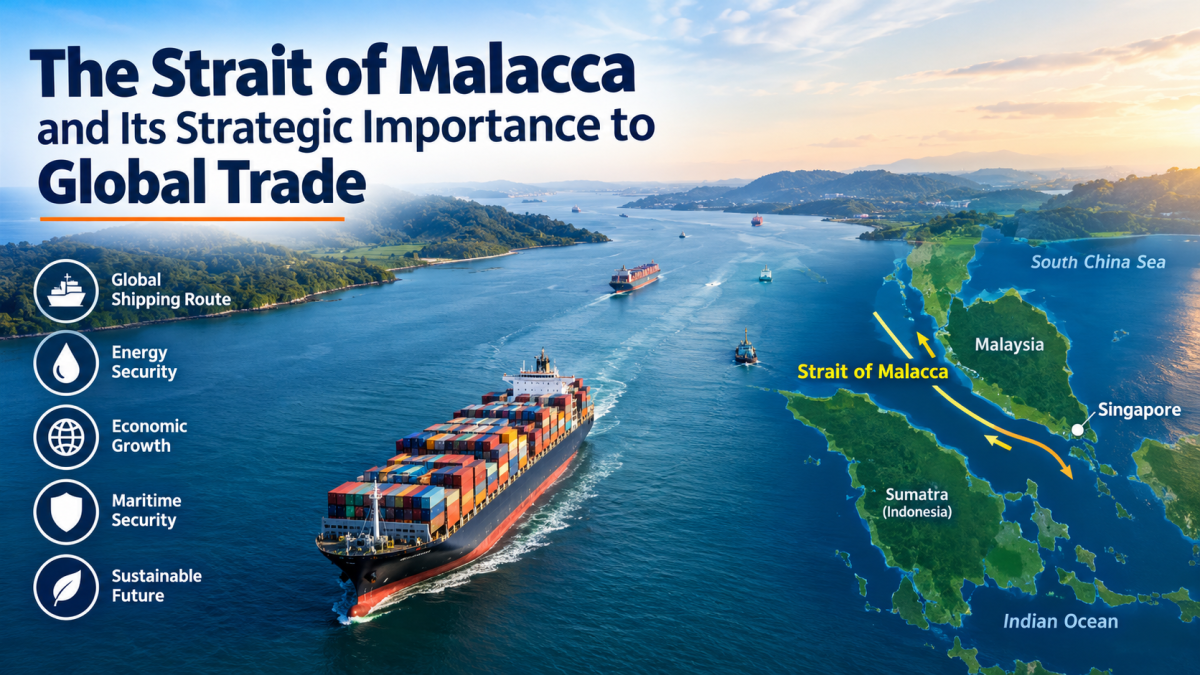
The Strait of Malacca and Its Strategic Importance to Global Trade
The Strait of Malacca is one of the world's most important maritime corridors, connecting the Indian Ocean with the Pacific Ocean through Southeast Asia. Located between the Malay Peninsula and the Indonesian island of Sumatra, this narrow waterway serves as a major route for international shipping, energy transportation and commercial exchange. Its geographical position makes it particularly important to China, India, Japan, South Korea and the wider global economy.
In an increasingly interconnected world, maritime routes are not merely commercial pathways. They are also strategic assets that influence national security, diplomatic relations and economic stability. The Strait of Malacca illustrates how geography can shape international power, particularly as major countries compete to secure energy supplies and protect access to global markets.
1. Understanding the Strategic Geography of the Strait of Malacca
The Strait of Malacca stretches for approximately 900 kilometres and provides one of the shortest maritime connections between the Middle East, South Asia and East Asia. It links major shipping networks across the Indian and Pacific Oceans, making it a crucial passage for vessels transporting oil, natural gas, manufactured goods and raw materials.
A Critical Link Between Two Oceans
The strait connects the Indian Ocean shipping network with the South China Sea and the wider Pacific region through the Singapore Strait. Its location allows vessels travelling between the Middle East and major Asian economies to avoid longer routes around the Indonesian archipelago.
This geographical advantage reduces journey times and transportation costs. For shipping companies operating under tight schedules, access to an efficient route can influence fuel consumption, freight charges and delivery times.
The strait is also connected to important regional ports, particularly Singapore, one of the world's leading maritime and logistics centres. The concentration of shipping, financial services, refuelling facilities and cargo-handling infrastructure around this region strengthens its importance to international commerce.
Why Geography Creates Strategic Importance?
The Strait of Malacca is an example of a maritime chokepoint—a narrow passage through which large volumes of international trade must travel. Chokepoints can become strategically sensitive because disruptions may affect shipping far beyond the immediate region.
The United States Energy Information Administration identifies the strait as the world's largest oil-transit chokepoint by volume. Its importance extends beyond energy, however, because it also supports container shipping, industrial supply chains and regional trade.
Consequently, developments affecting navigation through the strait can have implications for economies thousands of kilometres away.
2. The Strait of Malacca and Global Energy Security
Energy transportation is one of the principal reasons the Strait of Malacca occupies such a prominent position in global geopolitics. Major Asian economies depend on imported oil and gas to support transportation, manufacturing, electricity generation and industrial development.
A Major Route for International Oil Supplies
According to the US Energy Information Administration, approximately 23.2 million barrels of oil and petroleum liquids per day passed through the Strait of Malacca during the first half of 2025. This represented approximately 29 per cent of global maritime oil flows during that period.
The volume demonstrates how heavily international energy markets depend on a limited number of maritime routes.
Oil transported through the strait originates from several producing regions, including the Middle East. Major destinations include China and other East Asian economies, where energy demand remains closely linked to industrial activity and economic growth.
Any substantial interruption could delay deliveries, increase freight costs and place upward pressure on energy prices. The actual impact would depend on the duration of the disruption, available inventories, alternative routes and the response of energy producers and governments.
The Importance of Liquefied Natural Gas
The strait is also important for liquefied natural gas (LNG), which is transported by specialised vessels and used for electricity generation, industrial production and other energy requirements.
The US Energy Information Administration estimated that approximately 9.2 billion cubic feet of LNG per day travelled through the strait during the first half of 2025.
These flows connect energy suppliers with major Asian consumers. A prolonged disruption could therefore affect not only oil markets but also gas supplies, electricity costs and industrial operations.
For governments that rely heavily on imported energy, keeping maritime routes accessible is an important part of economic and national security planning.
3. China and the Strategic Importance of the Malacca Strait
China's dependence on maritime commerce makes the Strait of Malacca a significant factor in its foreign policy and security calculations. The country imports substantial quantities of energy and raw materials while exporting manufactured goods to markets worldwide.
China's Dependence on Maritime Energy Routes
A considerable proportion of China's seaborne energy imports travels through the strait. This creates a strategic vulnerability because supplies must pass through a geographically concentrated corridor before reaching Chinese ports.
The concern is not that disruption is inevitable, but that a serious crisis could complicate China's access to essential resources. A prolonged closure or major security incident could force vessels to change routes, increasing travel distances and costs.
Such a scenario would have implications for industrial production, shipping schedules and energy markets.
The Malacca Dilemma
The term "Malacca Dilemma" is commonly used in discussions of China's strategic concern about its dependence on the strait and the possibility that a major geopolitical confrontation could threaten access to this route.
China has pursued several approaches to reducing its exposure, including diversifying energy suppliers, developing strategic petroleum reserves, strengthening overland infrastructure and expanding economic connections across Eurasia.
Pipelines connecting China with neighbouring countries provide additional options for transporting certain energy supplies. However, pipelines cannot replace the full range of commodities and cargo carried by maritime shipping.
Diversification can reduce vulnerability, but it cannot eliminate the importance of secure sea lanes.
4. India and the Strait of Malacca
For India, the Strait of Malacca has both commercial and strategic significance. It connects the Indian Ocean with Southeast Asian economies and the wider Indo-Pacific region, making it important for trade, energy transportation and regional diplomacy.
India's Economic and Maritime Interests
India's expanding economic links with Southeast Asia rely partly on efficient maritime connections. Ships travelling between Indian ports and major markets in East Asia frequently operate through routes connected to the Strait of Malacca and the Singapore Strait.
Secure passage supports exports, imports, industrial supply chains and access to regional markets.
The strait also forms part of a wider maritime environment in which India seeks to protect freedom of navigation, strengthen cooperation with neighbouring countries and maintain stability across the Indian Ocean.
India's Indo-Pacific Strategy
India's maritime interests are connected to its broader engagement with the Indo-Pacific region. Through diplomatic partnerships, naval cooperation and participation in regional forums, India supports a stable maritime environment and the peaceful resolution of disputes.
The Andaman and Nicobar Islands, located near the western approaches to the Strait of Malacca, give India a geographically significant position in the eastern Indian Ocean.
However, geographical proximity does not mean that India controls the strait. Indonesia, Malaysia and Singapore are the principal littoral states responsible for managing their respective maritime jurisdictions and cooperating on navigation safety.
India's role is therefore best understood through regional cooperation, maritime awareness, diplomatic engagement and respect for international law.
5. The Role of Singapore, Malaysia and Indonesia
The Strait of Malacca is not simply a route used by major powers. It is also a vital regional asset for the countries whose coastlines border the waterway.
Indonesia, Malaysia and Singapore have direct interests in maintaining safe navigation, protecting marine ecosystems and supporting the economic activity associated with international shipping.
Singapore as a Global Maritime Hub
Singapore's location near the eastern end of the Strait of Malacca has helped it become a major centre for shipping, port services, logistics and maritime finance.
Its ports connect shipping networks across Asia, Europe, the Middle East and other regions. Disruptions to traffic around the strait could affect port operations, cargo schedules and related commercial services.
Singapore consequently has a strong interest in maintaining reliable navigation and effective coordination among maritime authorities.
Cooperation Between the Littoral States
Indonesia, Malaysia and Singapore cooperate on maritime safety, environmental protection and the management of navigation risks.
The International Maritime Organization supports cooperation through the Cooperative Mechanism on Safety of Navigation and Environmental Protection in the Straits of Malacca and Singapore.
This framework brings together the littoral states, user states and other stakeholders to support navigational safety and environmental protection.
Such cooperation is particularly important because the waterway serves international shipping while passing through areas under the jurisdiction of multiple states.
6. Maritime Security and the Threat of Disruption
The Strait of Malacca faces several security challenges, including piracy, attempted theft, navigational accidents, congestion and environmental hazards. Although the nature and intensity of these threats vary over time, they require sustained attention from maritime authorities.
Piracy and Maritime Crime
Incidents involving attempted theft and attacks on vessels can threaten crew safety, disrupt shipping operations and increase security expenses.
The US Energy Information Administration has highlighted piracy as a concern for vessels using the strait, including areas near Singapore.
Effective responses require information-sharing, surveillance, law enforcement and coordination between the countries concerned. Since vessels move across national maritime jurisdictions, cooperation is essential to address incidents effectively.
Congestion and Navigation Risks
The strait carries large volumes of commercial traffic through a relatively confined waterway. The movement of tankers, container ships, bulk carriers and other vessels creates operational challenges.
Collisions, groundings and accidental oil spills can cause serious environmental and economic consequences. Even an incident that does not involve a geopolitical confrontation could temporarily disrupt shipping.
Investment in navigation systems, emergency response capabilities, maritime traffic management and crew safety remains essential to maintaining the reliability of this international corridor.
7. Great-Power Competition and Regional Geopolitics
The Strait of Malacca sits within a wider strategic environment shaped by competition among major powers, including China, the United States and India.
These countries have different security priorities and economic interests, but all benefit from predictable maritime access and the uninterrupted movement of international commerce.
China–US Strategic Competition
The broader rivalry between Washington and Beijing influences discussions about naval activity, regional partnerships, maritime surveillance and freedom of navigation.
The Strait of Malacca is one component of this wider competition. Its importance arises from the dependence of both regional and global economies on secure shipping routes.
Nevertheless, the strait should not be viewed exclusively through the lens of military rivalry. Commercial shipping, port management, environmental protection and regional economic development are equally important to its long-term stability.
The Importance of International Law
International maritime law provides the framework for navigation through straits used for international passage. The United Nations Convention on the Law of the Sea establishes rules concerning transit passage, maritime jurisdiction and the rights and responsibilities of states.
Indonesia, Malaysia and Singapore reaffirmed their commitment to keeping the Straits of Malacca and Singapore open and safe for international shipping in a statement published by Singapore's Maritime and Port Authority on 25 August 2026.
Respect for international law helps reduce uncertainty and provides a basis for cooperation among coastal states and countries that use the waterway.
8. Alternative Routes and the Limits of Diversification
The possibility of disruption has encouraged governments and shipping companies to consider alternative maritime routes. However, alternative passages often involve trade-offs in distance, capacity, navigational conditions and operating costs.
The Sunda and Lombok Straits
The Sunda and Lombok straits, located within the Indonesian archipelago, offer alternative passages between the Indian and Pacific Oceans.
Their suitability depends on vessel dimensions, draught, destination and operational requirements. They cannot necessarily accommodate every ship using the Strait of Malacca under equivalent conditions.
A shift in traffic could also place additional pressure on other waterways and surrounding maritime infrastructure.
The Economic Cost of Longer Journeys
If ships are required to avoid the Strait of Malacca, longer routes could increase fuel consumption, insurance expenses, crew costs and delivery times.
These additional costs may be passed through supply chains, potentially affecting importers, exporters and consumers.
Alternative routes therefore provide a degree of resilience, but they do not remove the economic importance of keeping the Strait of Malacca open and safe.
9. Environmental Protection and Sustainable Maritime Development
The economic importance of the strait creates environmental responsibilities. Heavy vessel traffic increases the need to prevent pollution, manage maritime waste and protect coastal ecosystems.
Oil spills, chemical discharges and accidents can damage marine habitats and threaten fisheries and the livelihoods of coastal communities.
The Maritime Institute of Malaysia has highlighted the need to balance commercial development with environmental sustainability in the Straits of Malacca.
Long-term planning should therefore integrate navigational safety, emergency preparedness, pollution prevention and the protection of marine resources.
Environmental cooperation is not separate from maritime security. A major pollution incident can disrupt economic activity, place pressure on governments and create disputes between affected stakeholders.
10. The Future of the Strait of Malacca in Global Trade
The Strait of Malacca is likely to remain a central part of international shipping because of its geographical position and its connections to major Asian economies.
However, its future will depend on the ability of regional states and international partners to respond to evolving security, economic and environmental challenges.
Strengthening Regional Cooperation
Continued cooperation among Indonesia, Malaysia and Singapore will be important for safe navigation and effective maritime management.
Information-sharing, coordinated responses to emergencies, improved navigational infrastructure and respect for international law can help reduce the risk of disruptions.
Dialogue with countries that depend on the route can also support practical cooperation without undermining the rights and responsibilities of the littoral states.
Building Resilient Global Supply Chains
Governments and businesses can reduce their exposure to maritime disruptions through better risk assessments, diversified suppliers, strategic reserves where appropriate and contingency planning.
However, resilience should not be confused with complete independence from maritime chokepoints. International trade depends on interconnected transport networks, and no single alternative can replace every function of the Strait of Malacca.
The most effective approach combines reliable maritime access with preparedness for emergencies and cooperation among the countries involved.
Conclusion
The Strait of Malacca is far more than a narrow waterway in Southeast Asia. It is a critical link between the Indian and Pacific Oceans, a major route for international energy transportation and a strategic corridor connecting some of the world's largest economies.
Its significance extends from China's energy security and India's Indo-Pacific interests to Singapore's maritime economy and the wider international trading system. Security threats, congestion, environmental risks and great-power competition make effective management essential.
Ultimately, the stability of the Strait of Malacca depends on cooperation rather than confrontation. Protecting navigation, respecting international law and strengthening regional partnerships will be crucial to keeping this vital maritime corridor open, safe and reliable for global commerce.
Sources and Further Reading
1. U.S. Energy Information Administration — World Oil Transit Chokepoints
https://www.eia.gov/international/analysis/special-topics/World_Oil_Transit_Chokepoints
2. International Maritime Organization — Safety of Straits Used for International Navigation
3. Maritime and Port Authority of Singapore — Littoral States Reaffirm Commitment to Keep the Straits Open and Safe for International Shipping
4. Maritime Institute of Malaysia — Straits of Malacca
5. International Institute for Strategic Studies — Securing Sea Lanes: Maritime Choke Points in the Indian Ocean Region


Join the Conversation