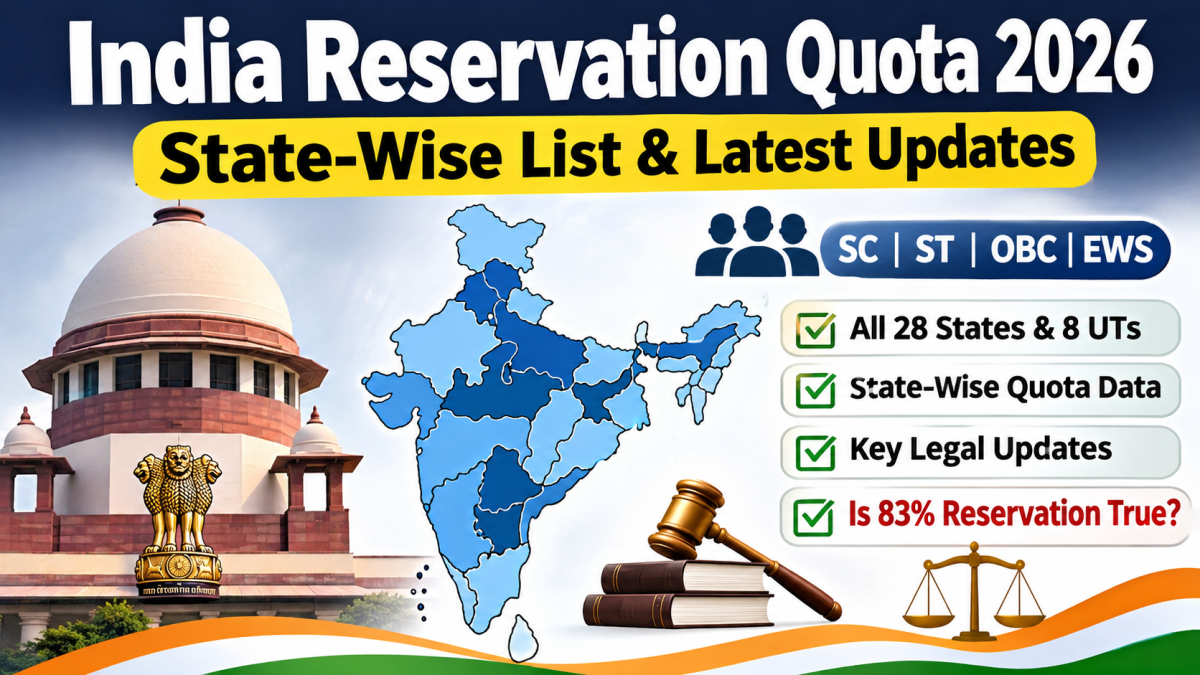
Reservation in India 2026: State-Wise Quota in All 28 States and 8 Union Territories; Is the 83% Reservation Claim True?
India's reservation policy has once again become a subject of national debate, with questions about higher quotas, constitutional limits, social justice and the role of the Supreme Court. Claims circulating online suggest that reservation in Bihar or Uttar Pradesh could rise to 83%, with a government reportedly submitting a proposal before the Supreme Court.
But what do the available records actually establish? Which states have higher reservation percentages, how do their policies differ, and what is the legal position in states where quota increases have been challenged?
An examination of government documents, reservation laws and recent court decisions reveals a complicated picture. India does not have one uniform reservation percentage for every state. The figures vary depending on the category, the institution, the type of recruitment and the applicable legal provisions.
The most important distinction is that an announced or proposed reservation increase is not necessarily an implemented or legally enforceable quota.
Is Bihar or Uttar Pradesh Increasing Reservation to 83%?
As of October 27, 2026, I could not verify an official government notification or Supreme Court filing establishing a new, general 83% reservation quota for Bihar or Uttar Pradesh.
The documented Bihar dispute concerns a different figure.
In November 2023, the Bihar government amended its reservation laws, increasing the quota for Scheduled Castes (SC), Scheduled Tribes (ST), Extremely Backward Classes (EBC) and Backward Classes (BC) from a combined 50% to 65%. A separate 10% EWS quota brought the announced overall reservation to 75%.
In June 2024, the Patna High Court struck down the two amendment laws. In July 2024, the state government appealed to the Supreme Court, which declined to grant interim relief at that stage. The challenge remained pending in the latest relevant legal records reviewed for this article.
Sources: Bihar government's Supreme Court appeal and the later judicial record discussing the pending appeal.
Uttar Pradesh has a separate reservation framework. Section 3 of the Uttar Pradesh Public Services (Reservation for Scheduled Castes, Scheduled Tribes and Other Backward Classes) Act, 1994, provides for 21% reservation for SCs, 2% for STs and 27% for OBCs in direct recruitment. EWS reservation is governed separately and applies under the relevant rules.
These figures give a 50% combined SC/ST/OBC allocation, or 60% when the applicable 10% EWS allocation is included.
Source: Uttar Pradesh reservation law.
Fact-check: The documented Bihar dispute involved a 65% quota for specified social categories, not an 83% quota. No verified evidence reviewed for this article establishes that a BJP-led government has filed a new proposal to create a general 83% reservation quota across Bihar or Uttar Pradesh. The claim should not be published as confirmed news without the original filing or an official notification.
Central Government Reservation Policy
Before comparing individual states, it is important to understand the central government's framework.
For applicable all-India direct recruitment by open competition, the central government's principal vertical reservation allocations are:
| Category | Reservation |
|---|---|
| Scheduled Castes (SC) | 15% |
| Scheduled Tribes (ST) | 7.5% |
| Other Backward Classes (OBC) | 27% |
| Economically Weaker Sections (EWS) | 10% |
| Total | 59.5% |
| Unreserved share | 40.5% |
The 10% EWS allocation applies to eligible people who are not covered under the existing SC, ST and OBC reservation scheme.
These percentages describe the relevant central-government framework. They must not automatically be applied to state government jobs, state university admissions or local-body elections.
Sources: Government of India's reservation policy and the government's EWS policy explanation.
State-Wise OBC and BC Reservation in India
The following table presents the OBC, Backward Class (BC) or Socially and Educationally Backward Class (SEBC) figures relevant to state government services, using the best available government references and more recent changes where verified.
These are not total reservation percentages. SC, ST, EWS and other applicable allocations are separate. The Government of India's main comparable state-wise OBC reply was published on April 6, 2022, so older figures are explicitly identified where later legal or policy developments matter.
A. All 28 States
| State | OBC/BC/SEBC reservation figure | Important context |
|---|---|---|
| Andhra Pradesh | 29% | Reported in the central government's 2022 reply. |
| Arunachal Pradesh | No OBC quota reported | The 2022 reply did not list an OBC allocation; separate tribal reservation provisions apply. |
| Assam | 27% | Reported OBC quota in state services. |
| Bihar | 33% in the 2022 reference | The subsequent 65% non-EWS-category increase was struck down by the Patna High Court; the appeal is a separate legal matter. |
| Chhattisgarh | 14% in the 2022 reference | The state's previous 58% reservation arrangement was struck down, and litigation concerning its implementation continues. |
| Goa | 27% | Reported OBC quota. |
| Gujarat | 27% | Reported OBC quota. |
| Haryana | 27% in Class III/IV; 10% in Class I/II | The applicable percentage varies by service category. |
| Himachal Pradesh | 12% or 18% | The reported figure differs between the applicable service categories. |
| Jharkhand | 14% in the 2022 reference | Higher proposed allocations must be distinguished from the quota applicable under current, enforceable rules. |
| Karnataka | 32% | The OBC allocation is distinct from the increase in SC/ST reservations struck down by the Karnataka High Court in October 2026. |
| Kerala | 40% | Reported Backward Class reservation figure. |
| Madhya Pradesh | 14% in the 2022 reference | Proposals and litigation over increasing OBC reservation need separate verification. |
| Maharashtra | 19% OBC | Other categories, including VJNT and special backward classes, have separate allocations. The 2024 Maratha/SEBC law provides a separate 10% allocation subject to applicable legal conditions. |
| Manipur | 17% | Reported OBC quota. |
| Meghalaya | No OBC quota reported | Community-specific reservation provisions operate separately. |
| Mizoram | No OBC quota reported | Tribal reservation provisions apply separately. |
| Nagaland | No OBC quota reported | Tribal reservation provisions apply separately. |
| Odisha | 11.25% in state government services | Education reservations differ by institution and course. See the explanation below. |
| Punjab | 12% | Reported OBC quota. |
| Rajasthan | 21% | The allocation for OBCs should be distinguished from separate Most Backward Class provisions. |
| Sikkim | 21% | Reported OBC reservation figure. |
| Tamil Nadu | 50% for BC/MBC categories combined | Tamil Nadu's overall reservation framework is 69%, including SC and ST allocations. |
| Telangana | 29% | Confirmed by the state's Backward Classes Welfare Department for education and employment. |
| Tripura | No OBC quota reported | Separate SC/ST reservation provisions apply. |
| Uttar Pradesh | 27% | The public-service law provides 21% SC, 2% ST and 27% OBC reservation in direct recruitment. |
| Uttarakhand | 14% | Reported OBC quota. |
| West Bengal | 7% for the 66 classes specified in the May 2026 notification | The current position differs from the earlier OBC-A/OBC-B structure; eligibility depends on the applicable list and rules. |
Sources and qualifications: Most historical OBC figures above come from the Ministry of Social Justice and Empowerment's parliamentary reply of April 6, 2022. Telangana's figure is confirmed by the official Backward Classes Welfare Department, Maharashtra's category structure is set out in its public-service reservation law, and the current West Bengal notification is available here. Odisha's state-service figure is supported by the National Commission for Scheduled Castes' Odisha report.
B. All 8 Union Territories
| Union Territory | OBC/BC reservation figure | Important context |
|---|---|---|
| Andaman and Nicobar Islands | 38% in the 2022 reference | Separate ST reservations also apply. |
| Chandigarh | 27% in the 2022 reference | Applicable rules depend on the recruitment framework. |
| Dadra and Nagar Haveli and Daman and Diu | Historical figures: 5% for Dadra and Nagar Haveli and 27% for Daman and Diu | These figures were reported separately in 2022, before treating them as a single combined UT would be appropriate. Check the applicable cadre rules for recruitment. |
| Delhi | 27% | Reported OBC quota; central and Delhi-government recruitment rules must be distinguished. |
| Jammu and Kashmir | 8% OBC under the revised rules | Other categories include SC, ST, residents of backward areas, residents of areas adjoining the LoC/International Border, and EWS. |
| Ladakh | No comparable OBC allocation reported in the 2022 table | The 2025 rules provide extensive ST and other category reservations, including a separate EWS allocation. |
| Lakshadweep | No OBC quota reported | Separate provisions relating to ST communities apply. |
| Puducherry | 34% | Reported combined backward-class reservation figure. |
The 2022 parliamentary reply is the source for the historical OBC figures. Later changes are documented in the Jammu and Kashmir Reservation Rules amendment and the official Ladakh administration announcement on its 2025 reservation rules.
Where a figure is marked as historical or not reported, it should not be interpreted as proof that no reservation currently exists. It means the relevant figure cannot safely be represented as a confirmed, current, universally applicable quota from the cited dataset.
Important Reservation Developments in 2025–2026
A national comparison must account for important state-specific legal developments. Several high-profile cases illustrate why a proposed or previously announced quota should not automatically be described as the current legal position.
1. Karnataka: High Court Strikes Down the Increase to 56%
On October 12, 2026, the Karnataka High Court struck down provisions of the 2022 state law that increased SC reservation from 15% to 17% and ST reservation from 3% to 7%. The change had raised the combined SC, ST and OBC allocation from 50% to 56%, with OBC reservation remaining at 32%.
The court held that the provisions taking the aggregate above the 50% ceiling violated constitutional equality principles. The judgment has direct implications for recruitment and admissions, and any subsequent appeal or interim order must be checked before stating the precise operative position for a particular notification.
Source: Bar and Bench's report on the October 2026 judgment.
2. Chhattisgarh: The 58% Reservation Arrangement Remains Subject to Litigation
Chhattisgarh's previous reservation notification raised the aggregate quota from 50% to 58%, with 12% for SCs, 32% for STs and 14% for OBCs. The High Court quashed that arrangement in September 2022.
In a judgment delivered on October 14, 2026, the Chhattisgarh High Court also set aside a teacher-recruitment advertisement to the extent that it relied on the previously quashed notification and associated reservation rosters. Recruitment processes protected by the Supreme Court's earlier order may continue subject to the ultimate outcome of the pending proceedings.
This is a useful reminder that a historical quota figure is not sufficient evidence that the same arrangement remains legally applicable.
Source: Chhattisgarh High Court judgment, Mehat Kumar v. State of Chhattisgarh.
3. Odisha: Different Quotas Apply to Services and Educational Admissions
Odisha illustrates why reservation figures must be compared within the same context.
The state has an 11.25% SEBC reservation allocation in government services. Its education policy has followed a separate course: a 2025 order introduced 17.25% SEBC reservation in specified higher-education institutions, while the 2026 changes for technical and medical education provided 16.25% for SCs, 22.5% for STs and 11.25% for SEBC students.
These figures concern different recruitment and admission frameworks. They should not be combined into one statewide quota without identifying the applicable policy.
Sources: Odisha government records and the state's 2025 higher-education memorandum.
4. Telangana: The Proposed 42% BC Quota Relates to Local Bodies
Telangana already provides 29% BC reservation in education and employment, according to its official Backward Classes Welfare Department.
The state's proposed 42% BC allocation for local-body elections is a separate issue. The legislation and government order encountered legal challenges, and reporting in late 2025 stated that the High Court had stayed the government order while the bills awaited presidential assent.
The 42% figure must therefore not be described as a statewide 42% quota for government jobs. The latest applicable orders should be checked before reporting the current position for local elections.
Sources: Telangana Backward Classes Welfare Department and The Indian Express report on the local-body quota dispute.
5. West Bengal: A Revised OBC Framework in May 2026
West Bengal's earlier reservation structure allocated 10% to OBC-A and 7% to OBC-B. Following court proceedings, the state issued a notification dated May 18, 2026, identifying 66 classes in the pre-2010 state OBC list for 7% reservation in state services.
The revised notification does not justify treating the former 17% allocation as uniformly applicable to every OBC class. The current eligibility position must be checked against the notified list and any subsequent orders.
Source: West Bengal government's May 18, 2026 notification.
Which States Have Higher Total Reservation?
Comparing only the OBC percentage does not reveal the total reservation applicable in a state. The following examples demonstrate the difference.
| State or jurisdiction | Overall reservation position | Qualification |
|---|---|---|
| Central Government | 59.5% | Applicable all-India direct recruitment framework: SC, ST, OBC and EWS. |
| Tamil Nadu | 69% | Long-standing state reservation framework under its 69% law. |
| Ladakh | 85%, excluding EWS | Its 2025 rules allocate 80% to STs, 4% to ALC residents and 1% to SCs. EWS reservation is separately 10%, leaving 5% unreserved under the stated framework. |
| Jammu and Kashmir | 60% across the specified vertical categories | The revised rules list SC 8%, ST 20%, OBC 8%, residents of backward areas 10%, ALC/IB residents 4% and EWS 10%, subject to the applicable rules. |
| Uttar Pradesh | 60% where the applicable 10% EWS allocation is included | SC 21%, ST 2% and OBC 27% in the relevant public-service framework, with EWS governed separately. |
| Bihar | The 65% amendment was struck down | The earlier enhancement must not be presented as an operative quota merely because an appeal was filed. |
| Karnataka | The 56% increase was struck down in October 2026 | The operative position must be assessed in light of the judgment and any subsequent orders. |
| Chhattisgarh | The previously notified 58% arrangement was quashed | Current recruitment must be assessed against the applicable judicial orders. |
Ladakh's figures are drawn from the official UT administration announcement, while Jammu and Kashmir's categories are set out in its 2024 reservation rules amendment.
Tamil Nadu's 69% framework is a long-standing statutory arrangement. The table is illustrative rather than an exhaustive statement of every special or horizontal reservation in these jurisdictions.
Why Reservation Cannot Be Compared Using a Single Percentage
There are several reasons a simple national ranking of reservation percentages can be misleading.
First, categories differ. SC, ST, OBC/BC and EWS allocations are not identical across states. Some states also have separate allocations for extremely backward classes, nomadic communities, special backward classes or other legally recognised groups.
Second, the type of opportunity matters. Government employment, undergraduate admission, postgraduate medical admission and local-body elections can have different reservation structures. A quota for panchayat elections cannot automatically be applied to government jobs.
Third, judicial decisions affect implementation. A quota announced by a cabinet, included in a bill, notified by a government or challenged in court may have a different legal status at each stage.
Fourth, horizontal reservations are different from vertical reservations. Provisions for women, persons with disabilities, ex-servicemen and other eligible groups may operate within category allocations rather than being added to the total in the same way as SC, ST, OBC or EWS quotas.
Finally, an unreserved seat is not necessarily a seat restricted to people outside reserved communities. Eligible candidates from reserved communities can compete for open-category seats on merit under the relevant rules.
What Is the Constitutional Position on Reservation Above 50%?
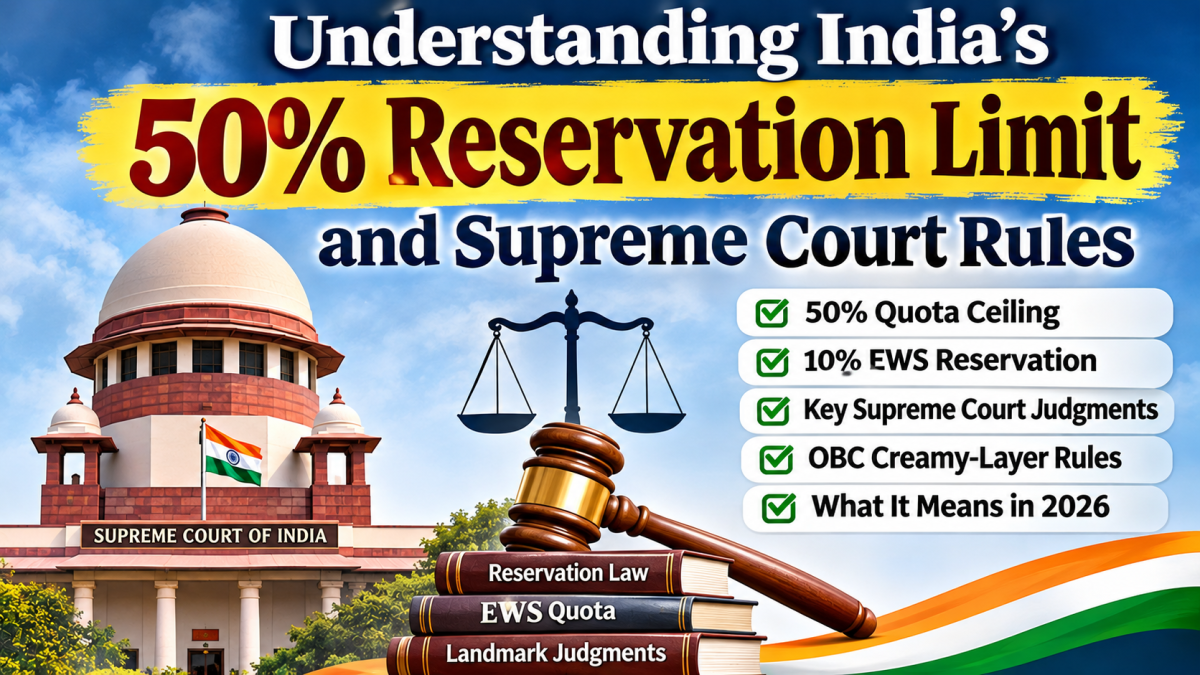
The Supreme Court's decision in Indra Sawhney v. Union of India established the general 50% ceiling principle for reservation, while recognising that exceptional circumstances may warrant a different assessment. The subsequent constitutional and legislative developments, including the EWS amendment and state-specific laws, have generated further litigation.
Tamil Nadu's 69% framework and the newer quota disputes in Bihar, Karnataka and Chhattisgarh illustrate the continuing legal questions around the ceiling.
However, it is inaccurate to say that every quota exceeding 50% is automatically invalid in every context, just as it is inaccurate to say that any state can raise reservation to any percentage simply by passing a law. The constitutional basis, the nature of the reservation, applicable precedent and the current court orders all matter.
Conclusion: The 83% Claim Requires Documentary Proof
India's reservation system is not uniform. State policies differ according to the allocation for SCs, STs, OBCs/BCs, EWS and special categories, and legal disputes can change the arrangements that apply to particular recruitment or admission processes.
The available evidence does not establish that Bihar or Uttar Pradesh has introduced a general 83% reservation quota, or that a BJP government has submitted a verified proposal for such a statewide increase to the Supreme Court.
The confirmed Bihar dispute concerned a 65% reservation amendment for specified social categories. That amendment was struck down by the Patna High Court, and the subsequent Supreme Court proceedings are a separate legal issue. Uttar Pradesh's standard public-service framework is also distinct from Bihar's.
Before reporting an 83% quota as breaking news, the original government notification, bill, Supreme Court petition or court order should be obtained and examined. Until documentary evidence establishes otherwise, the figure should be treated as unverified, not confirmed news.
Join the Conversation